Uptown New Orleans Catholic Church on Napolean Avenue - Monsignor Nalty
Rectory 504-899-1378 | Fax 504-899-0480
School 504-891-1927
ststephenpar@archdiocese-no.org


From the Pastor – March 31, 2024
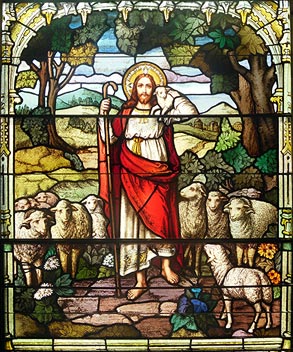 Think of what is above, not of what is on earth. For you have died, and your life is hidden with Christ in God. When Christ your life appears, then you too will appear with him in glory. Col. 3:2-4
One year while I was living in Rome, my parents came to visit me during the last week of Lent. Since my Dad is a permanent deacon, he sat next to me on the altar when we celebrated Mass at the beautiful church of St. Alphonsus near St. Mary Major where the original image of Our Lady of Perpetual Help is enshrined. As it came time to read the Gospel, my Dad came and asked for a blessing, after which then he began to solemnly intone “Al-le-luia! Al-le-luia! Al-le-luia!” I quietly said: “Shhh! We don’t say that now. It’s Lent!” He quickly whispered that since we were celebrating a Solemn Mass of Our Lady of Perpetual Help (a “Solemnity”) the Alleluia was allowed. Despite my instruction, the Alleluia was loudly proclaimed by my deacon Dad, and some of the Catholics of Rome got a brief respite from the austerity of Lent that morning!
As my Dad learned later (through some help from a certain priest…), the Alleluia is never sung during Lent liturgies in the Latin rite. In fact, a lot of people take care to not even say the “A-word” during Lent.
Why is that? Well, the Alleluia is a word of joy to recognize God in His Heavenly Glory. During Lent, our focus is on the Kingdom coming, not on the Kingdom come. The readings for Lent focus on the spiritual journey of Old Testament Israel toward the coming of Christ and the salvation of mankind through His death and resurrection.
During Lent, we are also on a spiritual journey, toward the Second Coming and our future life in Heaven. In order to emphasize that journey, the Church removes the Alleluia from the Mass during Lent. In some monastic communities, there’s even a tradition of burying a scroll upon which is written “Alleluia” on Ash Wednesday to be reopened and proclaimed on Easter Sunday.
During the austere Lenten season, we no longer sing with the choirs of angels; instead, we acknowledge our sins and practice repentance so that one day we may again have the privilege of worshipping God as the angels do. Then, the return of the Alleluia comes triumphantly at the Easter Vigil when the triple Alleluia is chanted before the Gospel, and everyone present responds with a triple Alleluia. The Lord is risen! The Kingdom has come! Our joy is complete! In concert with the angels and saints, we greet the risen Lord with shouts of “Alleluia!”
Although my Dad is no longer with us, I fondly remember the way he guided me during our earthly journey together. And I have the sure and certain hope that he is now proclaiming the “Alleluia” at the Eternal Banquet of Easter joy!
(Very Rev. Msgr.) Christopher H. Nalty
msgr.nalty@gmail.com
Masses
St. Stephen
Saturday Vigil at 4:00 pm
Sunday at 8:00 am and 10:30 am
Sunday at 5:00 pm at OLGC
Our Lady of Good Counsel (OLGC)
Center of Jesus the Lord
Charismatic Mass
Sunday at 10 am
Weekdays Masses
Monday – Friday 6:30 am St. Henry
Tuesdays 6:00 pm St. Stephen
First Fridays 6:00 pm Latin Mass
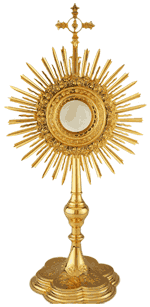
Adoration of the Blessed Sacrament
Tuesdays 4:45 – 5:45pm St. Stephen
Thursdays 7:00 – 8:00am St. Henry
Confession Times at Good Shepherd
Saturdays 3:00 – 3:45pm St. Stephen
Sundays 9:30 – 10:15am St. Stephen
Sundays 10:00 – 10:30am OLGC
First Fridays 6:30 – 7:00pm OLGC
Alleluia!
Easter Sunday is the day of the “Alleluia!” After forty days of Lenten sacrifice and fasting, we finally arrive at the most important day of our liturgical year, and the only word we have to express our inner joy is “Alleluia!!”
In the old Greek version of the Book of Tobias, in the Septuagint Greek translation of the Hebrew psalter, and in the original Greek of the Apocalypse we hear about this most holy word. It is part of the earliest Christian liturgies of which we have record.
It is a word composed of the divinely acclaiming verbal form Allelu and the divine pronoun term Ya (for YHWH or Yahweh). So, preserving its radical sense and sound, and even the mystical suggestiveness of its construction, it may be literally rendered, “All hail to Him Who is!”–taking “All Hail” as equivalent to “Glory in the Highest,” and taking “He Who is” in the sense in which God said to Moses: “Thus shalt thou say to the children of Israel; WHO IS hath sent me to you.” The ancient Jewish and Christian tradition all point to the conclusion that the “Alleluia” belonged to the Hebrew liturgy from the beginning as a divinely authorized doxology. As to when it was first formed, much evidence points to it being one of man’s most ancient formulas of monotheistic faith–the true believer’s primitive Credo, primitive doxology, primitive acclamation. That in part would explain remarkable fondness for its liturgical use. As a rule the Church uses it wherever joy is to be emphatically expressed, especially as to triumph or thanksgiving.
The “Alleluia” is a great characteristic of Easter, as it has an important place in all of the liturgies, constantly appearing at the beginning and end, and even in the middle, of psalms, as an instinctive exclamation of ecstatic joy.
The very sound of the words should be held to signify a kind of acclamation and a form of ovation which mere grammarians cannot satisfactorily explain; this is the reason why the translators of the Old Testament have left it untranslated, and the Church has taken it into the formulas of her Liturgy or of the people who use it at any time or place where joy need be expressed for God’s greatness and love! Alleluia! Praise God!
Altar of Repose
Mass of the Lord’s Supper
At the Mass of the Lord’s Supper on Holy Thursday (7:00 PM) sufficient hosts are consecrated for that Mass and for the next day. These consecrated Hosts remain in a ciborium on the corporal in the center of the altar until the end of Mass, after which they are carried in Solemn Procession to the Altar of Repose, with the priest vested in a Cope and Humeral Veil, and covered with a canopy. The Blessed Sacrament remains in the temporary tabernacle at the Altar of Repose, and the Holy Thursday service concludes with the stripping of all altars except the Altar of Repose.
Holy Thursday is a day of exceptional devotion to the Blessed Sacrament, and the repository is the center of the love, prayers and aspirations of the faithful. After the Good Friday service, the Blessed Sacrament remains available only as viaticum for the dying and for Communion given on Good Friday at the service called The Veneration of the Cross (Good Friday at 3:00 PM). While the Blessed Sacrament remains in this temporary tabernacle at the altar of repose, a lamp or candle is always kept burning.
On Holy Thursday we will celebrate the Mass of the Lord’s Supper at 7:00 PM, which commemorates the institution of the Holy Eucharist when Jesus washed his Apostle’s feet. This Mass begins the Sacred Triduum. This year Adoration at this Altar of Repose will take place all night, from the end of the Holy Thursday Mass until the sun rises on Good Friday at 6:00 AM.
PLEASE SIGN-UP to take an hour or a half-hour of the Vigil! Sign-up sheets are in the back of church.
Easter Baskets for the Needy
We will again be distributing “Easter Baskets” with food items to families in need so they can enjoy a traditional holiday meal. Please check out our Easter display in the rear of church for basket item suggestions. We would ask that all donations be returned by Sunday, March 24, 2024.
Lenten Guidelines
THE LENTEN SEASON
A distinction is to be made between Lent and the Easter Triduum. Strictly speaking, Lent ends with the beginning of the Triduum on Holy Thursday. The Ordo notes: “Lent runs from Ash Wednesday until the Mass of the Lord’s Supper exclusive on Holy Thursday.”
FASTING AND ABSTINENCE
Fasting is to be observed on Ash Wednesday and Good Friday by all Catholics who are 18 years of age but not yet 59. Those who are bound to fast may take only one full meal. Two smaller meals are permitted if necessary to maintain strength according to each one’s needs, but eating solid foods between meals is not permitted. Abstinence from meat is to be observed by all Catholics 14 years or older on Ash Wednesday, Good Friday and on all Fridays of Lent. The determination of certain days as obligatory days of penance should not be understood as limiting the occasions for Christian penance.
MAINTAINING THE SPIRIT OF OF LENT
The Spirit of the season of Lent should be maintained throughout the weeks of Lent. The obligation to observe penitential days of the Church is a very important part of our spiritual life. Individual circumstances must be taken into account, but in general, people should seek to do more rather than less, since fast and abstinence on the days prescribed should be considered a minimal response to the Lord’s call to penance and conversion of life.
Requiem Mass Wednesday, February 28, 2024 at 11 am
 It is with the most profound sadness that we inform you of the death of our longtime Director of Religious Education, our dear friend, Phillip Bellini.
Phillip had such a tremendous love of the Catholic Faith and a zeal for the Salvation of Souls that he devoted his entire life to teaching the Gospel of Jesus Christ, 15 years of which he did in our parish. He will be greatly missed by his friends, our parishioners and everyone to whom he taught the Catholic Faith over the last 35 years. Eternal Rest grant unto to Phillip, O Lord, and let Perpetual Life shine upon him! May he Rest in Peace. Amen.
The Precepts of the Church
“Now when they heard [Peter’s preaching] they were cut to the heart, and they said to Peter and the rest of the apostles, Brethren, what shall we do?” (Acts 2:37).
When the people heard Peter and the apostles preaching about Christ, they instinctively asked, “What shall we do?” Over the centuries, the Church has given answers to this question, adapting the unchangeable elements of the Christian vocation to the pastoral requirements of each age. In our times, the responses to this question are summed up in what have come to be known as “The Precepts of the Church,” which are derived from Catholicism’s moral and doctrinal foundations. The Cathechism of the Catholic Church, nos. 2041-2043, lists five precepts of the Church, listed and briefly discussed below.
Attend Mass on Sundays and on holy days of obligation, and rest from servile labor.
Weekly Sunday Mass is obligatory for all Catholics. There are very few factors that might excuse Sunday Mass attendance, such as personal illness or serious infirmity, the need to attend to someone suffering from the same, significant travel, or certain jobs affecting public safety or welfare.
Confess your sins at least once a year.
Catholics above the age of discretion (about seven years of age) are required to confess their grave sins to a priest at least once per year, at any time during the year.
Receive the sacrament of the Eucharist at least during the Easter season.
This reception of the Eucharist can take place any time in the Easter season, from the First Sunday of Lent to Trinity Sunday (after Pentecost).
Observe the days of fasting and abstinence established by the Church.
On Fridays in Lent Catholics, aged 14 and older, are bound to abstain from meat. On Ash Wednesday and Good Friday, Catholics aged 18 to 59 inclusive, are also bound to fast, by taking only one full meal and two smaller meals (together not to equal the one full meal), with no snacking between the meals.
Help provide for the needs of the Church.
The Church leaves to individual Catholics the right to determine precisely when and how they will assist with the temporal needs of the Church. However, the lack of specificity in Church law should not be taken as a sign that it may be ignored. Sunday collections, annual appeals, spontaneous offerings, bequests and wills, and so on are all ways that Catholics have to satisfy this precept of support.
The Story of the Palms
 It was a common custom in many lands of the ancient Middle East to cover in some way the path of someone thought worthy of the highest honor. In 2 Kings 9:13 Jehu, son of Jehoshaphat, was treated to this honor. Each of the four Gospels report that the people of Jerusalem gave Jesus the honor of walking on a covered path. However, in the synoptic Gospels (Matthew, Mark and Luke) we hear that the people lay their garments and cut rushes to place on the street. Only the Gospel of John specifically mentions palms.
So what is the significance of the palm? The palm branch was a symbol of triumph and of victory in Jewish tradition, and is treated as such in other parts of the Bible (e.g. Leviticus 23:40 and Revelation 7:9). Based on this significance, the scene of the crowd greeting Jesus by waving palms and carpeting his path has given the Christian celebration its name. It shows the freedom desired by the Jews, and their desperation to have political freedom. In fact, they were welcoming their “Messiah,” whom they expected to be a great king who would free them from the oppression of foreign rulers. The entry of Jesus into Jerusalem included chants from Psalm 118 and 148:1. The Hebrew hoshiiah na’ (I beseech you, save now) was changed in Greek to hosanna, which became a famous Christian term, and had a huge Messianic significance.
The palm is a symbol of victory for us as Christians. Since we recognize that Jesus is the Messiah (a word which we normally use in the Greek translation – “Christ”), we recognize that He has already achieved a victory for us. But the victory is not over earthly rulers. It’s much bigger. It’s victory over Satan. It’s a victory over sin and death. It’s a victory that gives us Eternal Life.
Palm Branches Needed
If any parishioner has access to sago palms (the kind pictured above), we would love to get some for decorations in the church, and for the procession on Palm Sunday, March 24, 2024. Please cut palms and bring them to the church this Thursday or Friday! Please call the office if you can help.
Altar Server of the Year
Altar Servers play a very important role in the Sacred Liturgy. They are part of the procession, handle incense, help prepare the altar for Mass, aid with baptisms, and help with the sacred vessels. Each year the Archdiocese honors altar servers from around the parish that have been nominated by their parish. This year our “altar server of the year” is our newest server: Nathaniel J. Almon!
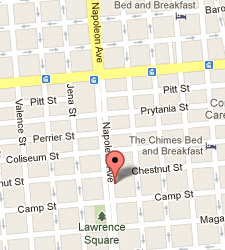
Location Map
Join Knights of Columbus
NOLA Adoration Chapels