Uptown New Orleans Catholic Church on Napolean Avenue - Monsignor Nalty
Rectory 504-899-1378 | Fax 504-899-0480
School 504-891-1927
ststephenpar@archdiocese-no.org


From the Pastor – August 2, 2026
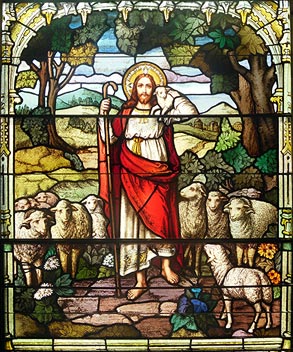 When it was evening, the disciples approached Jesus and said, “This is a deserted place and it is already late; dismiss the crowds so that they can go to the villages and buy food for themselves.”
Jesus said to them, “There is no need for them to go away; give them some food yourselves.”
But they said to him, “Five loaves and two fish are all we have here.” Then he said, “Bring them here to me,” and he ordered the crowds to sit down on the grass. (Mt. 14:15-17)
The miracle of the loaves and the fishes is the only miracle that occurs in each of the four Gospels. It points back to the Old Testament when the Israelites were fed in the desert with Manna from Heaven; and it points forward to the Eucharist when we are fed by Jesus with the Bread of Life. But we can’t deny the implications of this Gospel passage to the social teachings of the Church, especially what the Church calls “the preferential option for the poor.”
Today’s Gospel today emphasizes how taking care of the poor should work. When the disciples saw the huge crowds, they wanted to send them away to fend for themselves. But Jesus wanted the disciples to take responsibility for their welfare. He tells them: “There is no need for them to go away; give them some food yourselves.” Very often, we can act the same way as the disciples. We might forget that it’s our responsibility to care for the poor. We might want to pass the buck: “I pay taxes; let the government take care of it.” But that’s not what the Gospel says. Even the Code of Canon Law says: “The Christian faithful are also obliged to promote social justice and, mindful of the precept of the Lord, to assist the poor from their own resources.”
We are blessed to be part of a parish that has a long and outstanding record of service to the poor. Since the time the parish was founded in 1849, the Vincentian family has had a special mission to serving Jesus in the poorest members of our society. In the Gospel today, Jesus could have done a miracle to feed the hungry without the help of His disciples. But He didn’t do that. He wanted to start with the generosity of the disciples, and have the miracle proceed from that generosity. As Pope Benedict XVI wrote recently: “love for widows and orphans, prisoners, and the sick and needy of every kind, is as essential as the ministry of the sacraments and preaching of the Gospel.”
Finally, don’t forget what Jesus said about the day of judgment when He’ll ask us what we did to help the poor and needy. “Amen, I say to you, whatever you did for one of these least brothers of mine, you did for me.”
(Very Rev. Msgr.) Christopher H. Nalty
Masses
St. Stephen
Saturday Vigil at 4:00 pm
Sunday at 8:00 am and 10:30 am
Sunday at 5:00 pm at OLGC
Our Lady of Good Counsel (OLGC)
Center of Jesus the Lord
Charismatic Mass
Sunday at 10 am
Weekdays Masses
Monday – Friday 6:30 am St. Henry
Tuesdays 6:00 pm St. Stephen
First Fridays 6:00 pm Latin Mass
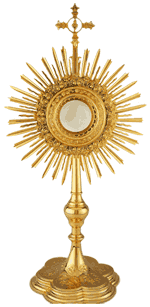
Adoration of the Blessed Sacrament
Tuesdays 4:45 – 5:45pm St. Stephen
Thursdays 7:00 – 8:00am St. Henry
Confession Times at Good Shepherd
Saturdays 3:00 – 3:45pm St. Stephen
Sundays 9:30 – 10:15am St. Stephen
Sundays 10:00 – 10:30am OLGC
First Fridays 6:30 – 7:00pm OLGC
Christmas in July!
The St. Vincent de Paul Society needs your help. During the hot summer months, we have many asking for help with their utility bills. A Christmas Giving Tree has been set up next to the St. Anthony Statue. All you have to do is pick an envelope and place in a donation. The Society of St. Vincent de Paul will do the rest! God bless you!
Feast of St. Ignatius Loyola – July 31
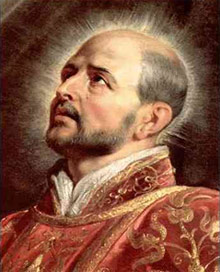
Ignacio López de Loyola was born in Spain in 1491, the youngest of 13 children. In 1506, he adopted the last name “de Loyola” in reference of the Basque city of Loyola where he was born. In 1509, Ignatius took up arms under the Duke of Nájera and participated in many battles without injury to himself. However, on May 20, 1521, in a battle against the French, a cannonball wounded both of his legs. During his recuperation at Loyola, Ignatius read the Life of Christ by Ludolph of Saxony, a commentary on the Gospels with extracts from the works of over sixty of the Fathers of the Church; the book influenced his whole life. Ludolph proposes that the reader place himself at the scene of a Gospel story and visualize the scene in a simple contemplation.
During his recuperation at Loyola, Ignatius read the Life of Christ by Ludolph of Saxony, a commentary on the Gospels with extracts from the works of over sixty of the Fathers of the Church; the book influenced his whole life. Ludolph proposes that the reader place himself at the scene of a Gospel story and visualize the scene in a simple contemplation. He also read the lives of the saints.
When Ignatius left Loyola he had no definite plans for the future, except that he wished to rival all the saints had done in the way of penance. His first care was to make a general confession at the famous sanctuary of Montserrat, where, after three days of self-examination, and carefully noting his sins, he confessed, gave to the poor the rich clothes in which he had come, and put on garment of sack-cloth reaching to his feet. His sword and dagger he suspended at Our Lady’s altar, and passed the night watching before them. The next morning, he retired to a cave near the neighboring town of Manresa, where he retired for prayer, austerities, and contemplation, while he lived on alms.
It was at this time, too, that he began to make notes of his spiritual experiences, notes which grew into the little book of “Spiritual Exercises.”
St. Ignatius spent a number of years studying in Paris, where he became thoroughly versed in the science of education, and learned by experience how the life of prayer and penance might be combined with that of teaching and study. Starting a small society in Paris, the Society of Jesus was approved by the Holy See in 1540. He died on July 30, 1556 and was canonized in 1622.
Currently, the Jesuits are the single largest religious order in the world, numbering nearly 20,000 members, of which nearly 14,000 are priests. They work in 112 nations on six continents.
Ignatian Volunteer Corps
ENRICH YOUR RETIREMENT – ENRICH THE LIVES OF OTHERS
Are you retired or finished raising your family? Do you want to give back, enrich your spiritual life and build community with other mature adults? Then consider joining the Ignatian Volunteer Corps (IVC) here in New Orleans. At IVC we believe the life experience, wisdom, and skills of 50+ women and men, rooted in Gospel values, can bring justice, and transform the world. For more details, visit our website at ivcusa.org/ivc-offices/welcome-to-ivc-new-orleans, or contact Becky Goff (Regional Director) at bgoff@ivcusa.org.
Feast of St. Henry Mass July 11th Vigil Mass
Saturday, July 11, 2026
THE VIGIL MASS IS MOVED TO ST. HENRY CHURCH!
Next Saturday at 4:00pm, there will be the annual St. Henry Feast Day Mass at St Henry Church, followed by a small reception at Grits Bar, located at 530 Lyons Street. If you went to St. Henry’s School, attended Mass at St. Henry, are named Henry, been to Henry’s bar, or have ever met anyone named Henry, you are invited!
St. Henry (6 May 973 – 13 July 1024) was the fifth and last Holy Roman Emperor of the Ottonian dynasty, from his coronation in Rome in 1014 until his death a decade later. He was crowned King of Germany in 1002 and King of Italy in 1004. He is the only German king to have been canonized.
Henry was the son of Henry, Duke of Bavaria. As his father was in rebellion against two previous emperors, he was often in exile. This led the younger Henry to turn to the Church at an early age, first finding refuge with the Bishop of Freising, and later being educated at the cathedral school of Hildesheim. He succeeded his father as Duke of Bavaria in 995 as Henry IV.
Henry’s most significant contributions as emperor came in the realm of church-state relations and ecclesiastic administration within the Empire. He supported the bishops against the monastic clergy and aided them in establishing their temporal rule over broad territories. He strongly enforced clerical celibacy in order that the public land and offices he granted the church would not be passed on to heirs. This ensured that the bishops remained loyal to him, from whom they received their power, and provided a powerful bulwark against rebellious nobles and ambitious family members. Henry founded the Diocese of Bamberg, which quickly became a center of scholarship and art.
Henry had been working with the pope to call a Church Council to confirm his new system of politico-ecclesiastical control when he died suddenly in 1024, leaving this work unfinished. Henry was canonized in July, 1147 by Pope Clement II; and his wife, Cunigunde, was canonized in the year 1200, by Pope Innocent III. His relics were carried on campaigns against heretics in the 1160s. He is buried in Bamberg Cathedral. Because as king he supported the Church, Henry is usually portrayed wearing a crown and holding a small model of a church.
Solemnity of Peter and Paul
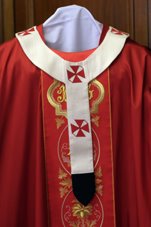 On Monday, June 29, the Solemnity of Sts. Peter & Paul, the Holy Father, Pope Leo XIV will bestow the pallium (pictured above, plural “pallia”) on the metropolitan archbishops named during the last year, including our own Archbishop James Checchio. The pallium is a narrow band of cloth woven of white lamb’s wool with a ring in the center which rests on the shoulders of its wearer. The narrow band falls down the front of the chest like a necktie and goes similarly down the back. It is decorated with six black crosses, one on each tail and four on the loop. The pallium has its origin as a liturgical vestment of the Holy Father since at least the 4th century, and it has been given to each Metropolitan Archbishop since at least the 9th century.
The story of how the pallium is made gives clues to its symbolism. The wool comes from lambs raised by Trappist monks. On, January 21, the Feast of St. Agnes (“agnes” is from the Latin word for lamb), the lambs whose wool is destined for the making of the pallia are solemnly blessed at the Basilica of Saint Agnes. Wool from these lambs is then given to the Benedictine nuns of the Basilica of St Cecilia in Trastevere, and they weave the pallia. The new pallia are solemnly blessed at the Basilica of St. Peter after the Second Vespers on the feast of Sts Peter & Paul, and are then stored in a special golden chest located directly above the original tomb of St. Peter. It is called the “Niche of the Pallia.” There are two connections here, the wool on the shoulders calls to mind the Good Shepherd and storing the pallia over the tomb of St. Peter symbolizes the unity of the bishops with St. Peter and his successors.
Worn by the Pope, the pallium symbolizes the plenitudo pontificalis officii (i.e., the “fullness of pontifical office”). When worn by metropolitan archbishops, it signifies the power which the metropolitan, in communion with the Roman Church, has by law in his own province. If you’re ever at St Louis Cathedral on a Sunday, notice Archbishop Checchio’s pallium. It’s a great reminder of the universality and long history of our Church.
Feast of the Transfiguration – Aug 6
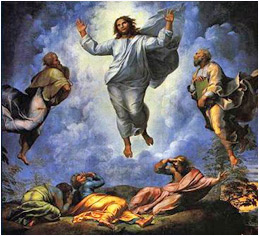
While he was still speaking, a cloud came and cast a shadow over them, and they became frightened when they entered the cloud. Then from the cloud came a voice that said, “This is my beloved Son; listen to him.” (Lk 9:34-36a)
Most of the Church Fathers saw the Transfiguration as a glimpse of the glory of Christ given to his disciples so that they might be strengthened to witness the scandal of the Cross. And this is certainly true. But three things immediately jump out of the reading.
First, is the number of apostles. Not all of the twelve are present – only Peter, James and John, the same three apostles that would accompany Jesus into the Garden of Gethsemane. Even though they were strengthened by their witness to the glory of the Transfiguration, they would still flee at the beginning of the persecution of Christ.
The second point is the encounter between Jesus and Moses and Elijah. Of course, an easy connection can be made to Jesus being the fulfillment of the law (represented by Moses, who received the Ten Commandments) and the prophets (represented by the prototypical prophet Elijah). But it’s important to note what they are discussing on Mt. Tabor. Shrouded in glory, they’re not focused on Heaven’s glory but on the “exodus that He was going to accomplish in Jerusalem.” This exodus meant the passage Jesus would make from the slavery of death to the Promised Land of eternal life, a journey prefigured in the exodus by which Moses led the Jewish people out from the slavery in Egypt to the Promised Land of Israel. And the means by which Jesus would accomplish this exodus is His suffering and death. Once again, the Transfiguration points to the cross.
And then comes the third, penultimate point of the passage: God the Father speaks. He confirms His Son’s true identity. Jesus wasn’t John the Baptist, or Elijah, or one of the prophets, as many people believed. He wasn’t simply the long-awaited Messiah. God the Father thundered from heaven, “This is my beloved Son!” Then he gave a command to the three apostles with Jesus on the mountain: “Listen to Him!” The command echoes to us to listen to what Jesus said about his suffering and death, and believe in Him.
The encounter on Mt. Tabor is given for us to remember where we are headed. Is it to the glory of Heaven represented by the transfigured Lord? We hope so. But we can only get there through the Paschal Mystery: the suffering, death and resurrection of Jesus Christ.
St. John Vianney Feast Day August 4
Patron Saint of Parish Priests
Jean-Baptist-Marie Vianney was born on May 8, 1786, in the French town of Dardilly, the fourth child of Matthieu Vianney and Marie Beluze.
His life was impacted at a young age by the French Revolution, which forced many loyal priests to hide from the government in order to celebrate the Sacraments. Since priests daily risked their lives because of the religious persecution, Vianney’s early life as a Catholic was hidden, having received his First Holy Communion and Confirmation is secret ceremonies in private homes.
When the Catholic Church was re-established in France 1802, John’s father allowed him to begin studies for the priesthood in the neighboring village of Ecully at a school run by Father M. Balley. Although John’s studies were interrupted when he was drafted into Napoleon’s armies in 1809 (he never served), he was eventually ordained a priest on August 12, 1815 in the Couvent des Minimes de Grenoble, saying his first Mass the next day. He was appointed to Ecully as assistant to Msgr. Balley, his priest-hero because Balley had remained faithful during the Revolution.
As a parish priest, Vianney realized that the destruction of the Catholic Church during the French Revolution had led to great religious ignorance and indifference. He began to zealously catechize his parishioners, courageously condemn errors and lax moral practices and tirelessly call sinners to repentance, especially through Confession. St. Alphonsus Ligouri (Feast Day August 1) once said, “A priest needs to be a lion at the pulpit and a lamb in the confessional.” Vianney fit the bill.
After being appointed as the Cure of Ars (a small city near Ecully) Vianney came to be known internationally, and people from distant places began traveling to make their Confession to him. By 1855, the number of pilgrims had reached 20,000 a year. During the last ten years of his life, he spent sixteen to eighteen hours a day in the confessional.
On 4 August 1859, Vianney died at age 73. His bishop presided over his funeral with 300 priests and over 6,000 people in attendance. In 1925 he was canonized by Pope Pius XI. In honor of the 150th anniversary of Vianney’s death, Pope Benedict XVI declared a Year for Priests in 2009.
Dedication of the Basilica of St. Mary Major August 5, 2026
The Papal Basilica of St Mary Major (Santa Maria Maggiore) is the oldest and most important Marian sanctuary in Western Christendom and is the only one of the Papal Basilicas to have maintained its early Christian appearance.
Although it has been embellished and extended over the years, all the commissioning patrons have respected its original layout and design, which, according to tradition, was divinely inspired.
According to the traditional story of its foundation, the Virgin Mary appeared in a dream to the Patrician John and Pope Liberius, exhorting them to build a church dedicated to her on the exact spot where she would cause snow to fall. On the morning of the 5th of August in the year 358, snow was seen on the Esquiline Hill, the highest of Rome’s hills, outlining the perimeter of what was to become the new church.
Today that miraculous snowfall is still remembered when white rose petals fall from the ceiling of the Basilica during the feast day liturgy. This tradition gives a special nobility to St Mary Major’s – marking it out as a kind of Marian relic, a place that was desired and planned by the Mother of God herself.
The Basilica is home to the most important of all Marian icons, the Salus Populi Romani (Our Lady Savior of the Roman People). Tradition attributes the artwork to St Luke the Evangelist, the patron of painters. Pope Francis placed all his apostolic journeys under the protection of Our Lady, Salus Populi Romani, stopping off to pray at the icon before each of his departures from Rome and again on his return. He is buried adjacent to the chapel with the icon.
The relic of the holy crib, the bedding on which the baby Jesus was laid, which is under the Papal altar, recalls the importance of the Basilica as the “Bethlehem of the West.” Here, the first Christmas Midnight Mass was celebrated and for centuries the Popes came here to carry on that tradition.
Among the other important relics contained within the basilica are the mortal remains of St Matthew and St Jerome.
It was in St Mary Major’s that Pope Adrian II welcomed, in the year 867, Saints Cyril and Methodius and approved the use of the Slavic texts in the liturgy. Also worthy of note is that fact that seven other Popes are buried in the Basilica of St Mary Major.
(From the Vatican Jubilee website)
Need a Ride?

Occasionally, parishioners without transportation inquire at the parish office whether it is possible for another parishioner to give them a ride to and/or from Mass. If you need a ride to Mass, or you would be willing to provide transportation to a fellow parishioner, please contact the parish office at (504) 899-1378.
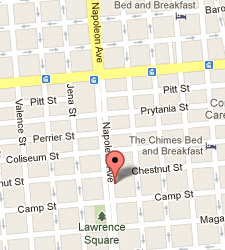
Location Map
Join Knights of Columbus
NOLA Adoration Chapels