

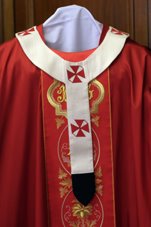
 On Monday, June 29, the Solemnity of Sts. Peter & Paul, the Holy Father, Pope Leo XIV will bestow the pallium (pictured above, plural “pallia”) on the metropolitan archbishops named during the last year, including our own Archbishop James Checchio. The pallium is a narrow band of cloth woven of white lamb’s wool with a ring in the center which rests on the shoulders of its wearer. The narrow band falls down the front of the chest like a necktie and goes similarly down the back. It is decorated with six black crosses, one on each tail and four on the loop. The pallium has its origin as a liturgical vestment of the Holy Father since at least the 4th century, and it has been given to each Metropolitan Archbishop since at least the 9th century.
The story of how the pallium is made gives clues to its symbolism. The wool comes from lambs raised by Trappist monks. On, January 21, the Feast of St. Agnes (“agnes” is from the Latin word for lamb), the lambs whose wool is destined for the making of the pallia are solemnly blessed at the Basilica of Saint Agnes. Wool from these lambs is then given to the Benedictine nuns of the Basilica of St Cecilia in Trastevere, and they weave the pallia. The new pallia are solemnly blessed at the Basilica of St. Peter after the Second Vespers on the feast of Sts Peter & Paul, and are then stored in a special golden chest located directly above the original tomb of St. Peter. It is called the “Niche of the Pallia.” There are two connections here, the wool on the shoulders calls to mind the Good Shepherd and storing the pallia over the tomb of St. Peter symbolizes the unity of the bishops with St. Peter and his successors.
Worn by the Pope, the pallium symbolizes the plenitudo pontificalis officii (i.e., the “fullness of pontifical office”). When worn by metropolitan archbishops, it signifies the power which the metropolitan, in communion with the Roman Church, has by law in his own province. If you’re ever at St Louis Cathedral on a Sunday, notice Archbishop Checchio’s pallium. It’s a great reminder of the universality and long history of our Church.